

In 2002, a major government-funded study changed the way millions of women thought about hormone replacement therapy. Overnight, women who had been managing their menopause symptoms effectively were told by their doctors to stop. The study found elevated risks of breast cancer and cardiovascular events. The message that spread through conventional medicine: hormones are dangerous.
What didn’t spread was the more complicated truth about what the study actually used.
The Women’s Health Initiative, the study in question, used conjugated equine estrogen, a synthetic compound derived from horse urine. It is not the same as the estrogen a woman’s body makes. The research was real. The panic was understandable. But applying those findings to bioidentical hormone replacement, a fundamentally different category of treatment, created a misunderstanding that still affects women’s care today.
What “Bioidentical” Actually Means
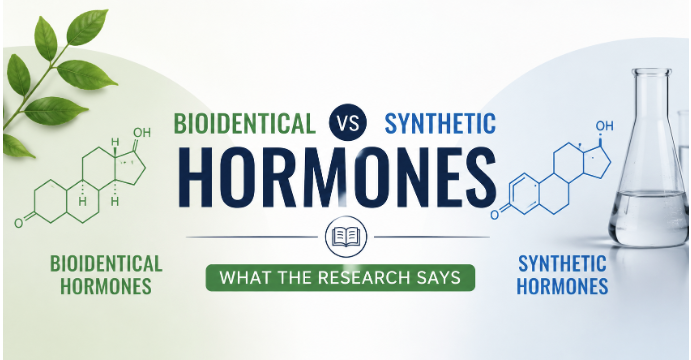
Bioidentical hormones are molecularly identical to the hormones produced by the human body.
That’s the core distinction. Not “more natural” in a vague wellness sense. Literally identical at the molecular level. When a bioidentical estradiol molecule binds to an estrogen receptor, it behaves exactly the way the body’s own estradiol would. The receptor can’t tell the difference, because there is no difference.
Synthetic hormones, by contrast, are molecularly similar but not identical. They’re close enough to produce some of the same effects, but the differences in structure mean they interact with receptors differently, they break down through different pathways, and they carry a different safety profile.
Bioidentical hormones used in replacement therapy are typically derived from wild yam or soy, plant sources that contain precursor compounds which are then converted in a laboratory into molecules that precisely match human estrogen, progesterone, and testosterone. The plant origin doesn’t make them more or less effective. The molecular identity does.
The Delivery Route Is As Important As the Compound
One of the most clinically significant findings in hormone therapy research concerns delivery method, specifically the difference between oral and transdermal estrogen.
Oral estrogen passes through the liver before reaching circulation. That first-pass metabolism increases the production of clotting factors and inflammatory proteins. This is the mechanism behind the elevated blood clot risk that’s been associated with oral estrogen therapy.
Transdermal estrogen, absorbed through the skin as a cream or patch, bypasses that first-pass liver metabolism. It enters the bloodstream more directly and doesn’t produce the same elevation in clotting factors. The safety profile is meaningfully different.
Most bioidentical hormone prescribing uses transdermal estrogen for exactly this reason. And this is one of the places where the Women’s Health Initiative data gets misapplied. The study used oral conjugated equine estrogen. The risk profile from that study doesn’t translate to transdermal bioidentical estradiol. They are not the same drug.
Oral progesterone, on the other hand, is bioidentical and is generally considered safe when dosed appropriately. It also has the advantage of a mild sedating effect that makes it particularly useful when sleep disruption is part of the clinical picture.
Why Conventional Medicine Still Prescribes Synthetics
This is a question that comes up often, and there isn’t a satisfying clinical answer.
There’s no evidence base showing that synthetic hormones produce better outcomes than bioidentical hormones for menopausal symptoms. Bioidentical hormones, because their structure matches the body’s own hormones, have a theoretically superior safety profile. Providers who specialize in hormone therapy consistently choose bioidentical options.
The continued use of synthetic hormones in conventional settings is largely a function of two things: cost and insurance coverage. Synthetic hormones are cheaper to produce and more likely to be covered by insurance plans. Prescribing them requires no specialized training and fits neatly into the conventional care model. The question of whether they’re the best option for the patient often comes second to the question of whether they’re covered.
There is no clinical reason to choose synthetic hormones over bioidentical ones. The providers who specialize in this work make that choice clear.
The Customization Advantage
Another significant difference between bioidentical and synthetic hormone therapy is the ability to individualize dosing.
Oral contraceptives and synthetic progestins come in fixed doses. The woman takes what’s prescribed, and there’s limited room to adjust. The dose doesn’t reflect her individual hormonal status, her symptom severity, or the specific balance her body needs between estrogen and progesterone.
Bioidentical hormone therapy is compounded or prescribed at precise doses that can be adjusted based on labs and clinical response. A provider can specify which subtype of estrogen to use: estriol, which is gentler, or estradiol, which is stronger. The progesterone dose can be calibrated to address sleep specifically. Testosterone, which matters for women too, can be added at an amount appropriate for female physiology without producing androgenic effects.
That level of precision requires expertise. Getting the estrogen-to-progesterone balance right matters. Adding testosterone without adequate estrogen in a postmenopausal woman can shift the balance toward androgenic effects. These are real clinical considerations that require someone trained in managing them, not just someone willing to write a prescription.
Monitoring Over Time
One of the myths around hormone replacement therapy is that once you start, you’re locked into a fixed protocol indefinitely. That’s not how it works when it’s done well.
After starting bioidentical hormone therapy, labs should be rechecked at around 10 weeks. That gives the treatment enough time to have an effect while still being early enough to adjust if something isn’t responding as expected. Following that, ongoing monitoring every few months allows for dose refinement as the woman’s hormonal environment changes.
Symptoms matter as much as numbers. If progesterone levels look adequate on blood work but the woman is still waking at 3 a.m., that’s a clinical signal. If estrogen looks good in serum but mood is still unstable, the Dutch test may reveal what the blood work is missing. Monitoring is a conversation, not a number-chasing exercise.
Clearing Up the Fear That Stayed After 2002
The Women’s Health Initiative created lasting fear about hormone therapy for women who might genuinely benefit from it. That fear was based on a study that used a synthetic compound, administered orally, in women who were already well past their menopause transition, many of them in their 60s and 70s.
The clinical picture for bioidentical hormone therapy in perimenopausal and early menopausal women, administered transdermally, with careful monitoring, is very different. The preventive benefits of maintaining appropriate hormone levels during the transition, reduced dementia risk, improved bone mineral density, cardiovascular protection, are compelling arguments for addressing this early.
Many women are still being told to avoid hormones altogether based on a misapplication of 20-year-old data. Asking whether that data applies to the specific type of hormone therapy being discussed, and who it applies to, is a reasonable and necessary question.
Making an Informed Decision
The conversation about hormones doesn’t have to be frightening. It benefits from being specific.
Which compound. Which delivery method. What dose. Monitored how. By someone with what level of training. These are the questions that determine whether hormone therapy is the right tool for a given woman, and whether it’s being used well.
A provider who dismisses the question entirely, or who offers only synthetic options without explanation, isn’t giving you the full picture. A provider who takes your symptoms seriously, runs a comprehensive panel, explains the distinction between bioidentical and synthetic, and monitors your response carefully is a much better guide for this particular decision.
About the Author: Dr. Sasha Rose is a naturopathic physician and licensed acupuncturist at Med Matrix, a functional medicine clinic in South Portland, Maine. She specializes in women’s hormone health, bioidentical hormone therapy, and root-cause approaches to perimenopause and menopause.